Chain Link Around a Pool or Dog Yard: Black or Galvanized, and What to Ask For
Chain link looks like the simplest fence there is, but a handful of details decide whether it lasts.
October 1, 2026 · 3 min read
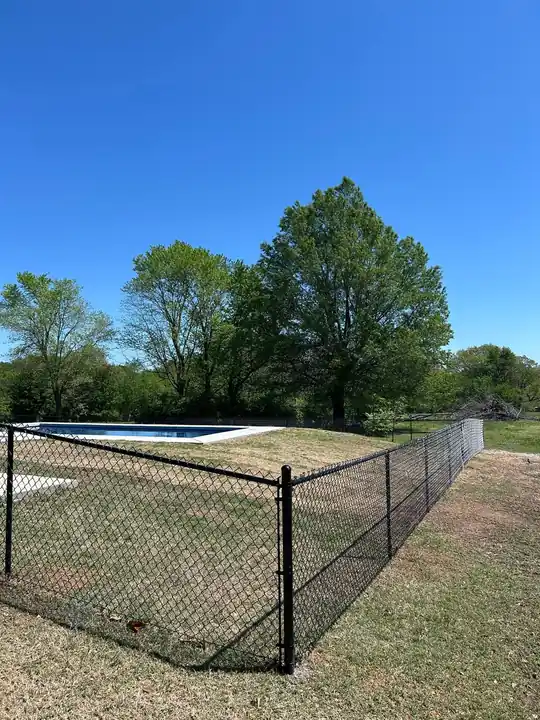
Chain link has a reputation as the plain, practical fence, and it earns it. It's strong, it keeps its shape, it lets you see through to the yard and it doesn't ask for much upkeep. Around a pool or a dog yard, it's often the right tool. The details are what separate one that lasts from one that bends, rusts or lets the dog out.
Black coated or galvanized
Standard chain link is galvanized steel wire, which means it carries a zinc coating that fights rust. It has that familiar silver look. It's tough and usually the lower-cost option, and it makes sense on utility areas where nobody cares about looks.
Black chain link is galvanized wire with a vinyl coating over the top. The coating adds a second layer between the steel and the weather, and it changes how the fence looks from the house. Black tends to disappear against trees, shadows and landscaping, so you see the yard instead of the fence. You see it on the black vinyl-coated chain link Fence Pros NWA has put around backyard pools, where the fence needs to protect the space without dominating it.
The coating isn't indestructible. A scrape from a mower or a deep chew from a determined dog can break through, and bare steel under a chip will eventually rust. For most homes the black option is worth it for looks alone, but ask what the coating is and how it's bonded to the wire.
Reading gauge and mesh size
Gauge is the thickness of the wire, and the number works backward: a lower gauge number means thicker, stronger wire. A heavier wire resists dogs that push, climb and chew, and it holds up to kids hanging on it. Lighter wire is fine for a basic boundary but it can stretch and bag out where the pressure lands.
Mesh size is the size of the diamond-shaped openings. Smaller openings are harder for paws to grab, and they keep small dogs from squeezing through. They also give a pool fence less of a ladder effect for little hands and feet. If climbing is a concern, say so when you talk to your installer.
The parts you can't see in a photo
- Terminal posts. The corners, ends and gate posts carry all the tension of the stretched mesh, so they need to be heavier and set deeper than the line posts between them.
- Top rail or tension wire. A top rail gives you a stiffer, straighter fence. A tension wire along the bottom keeps the mesh from lifting.
- Bottom protection. Dogs that dig will go under the fence. A buried wire, a concrete curb or a lower tension wire can stop that. Ask about it before the posts go in.
- Height. A taller fence matters if you have a jumper, but taller also means more wind load on the posts.
- Gate hardware. A gate that closes and latches on its own is a real convenience around kids and pets, and a good latch is the first thing a dog tests.
Pools are a regulated space
A fence around a pool isn't just a design choice. Cities set rules for pool barriers, and those rules cover things like height, gate latching and what can be climbed. We won't try to quote them here, because they change and they differ from town to town. Check with your city or your pool installer before you design anything, and make sure your fence plan matches what they require.
Call 811 before anyone digs
Whatever you build, every post means a hole, and a hole near a buried line is a bad day. Calling 811 before the digging starts gets utilities marked for free. Kyle Gauthier wrote in his Google review that his yard had "buried gas, electric & sprinklers to contend with," and that Sean and his crew communicated, executed and delivered a finished product better than he'd imagined. Planning around what's underground is part of the job, and it's much easier when the lines are already marked.
What to ask your installer
Ask what gauge the wire is, how big the mesh openings are, how deep the terminal posts are set, and what's protecting the bottom edge if you have a digger. Ask what the gate latch looks like. If the answers are vague, keep asking until they aren't.
If you're planning a chain link fence for a pool or a dog yard in Northwest Arkansas, you can call or text Sean at (479) 871-3942 for a free estimate, and he'll talk through color, height and gates for your setup.
Fence Pros NWA, (479) 871-3942
Call (479) 871-3942More articles
Why Fence Gates Sag, and What a Steel Frame Does About It
A gate is the one moving part on your fence, so it's the first place a cheap build shows.
Cedar or Pine for a Privacy Fence in Northwest Arkansas
Both woods work here, but they age differently, and knowing how helps you pick the one you'll be happy with.