Why Fence Gates Sag, and What a Steel Frame Does About It
A gate is the one moving part on your fence, so it's the first place a cheap build shows.
October 1, 2026 · 4 min read
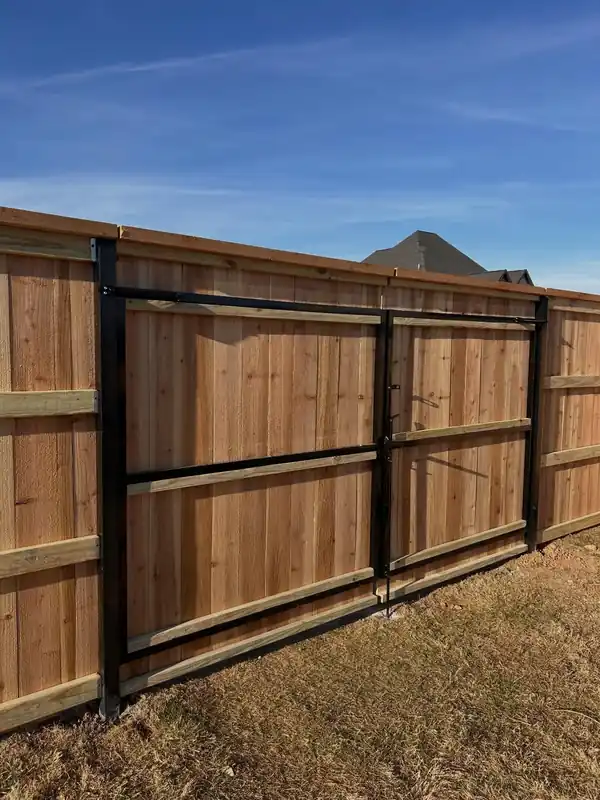
A gate is the only moving part on a fence, and it hangs its full weight off one edge every hour of every day. Posts and panels just stand there. A gate swings through an arc, catches the wind like a sail, and gets leaned on by kids and delivery drivers. If a fence is going to fail anywhere first, the gate is usually where you'll see it, and the sag tends to show up long before anything else looks tired.
What actually makes a gate sag
Picture a wooden gate as a rectangle hanging from two hinges on one side. The weight pulls straight down, and the latch side wants to drop toward the ground. The only things keeping that rectangle square are its frame and the diagonal brace running from the low hinge corner up to the high latch corner. Once the corners loosen, the rectangle slowly becomes a parallelogram, the latch side starts to drag, and one morning the gate won't close without a shove.
A few things push a gate in that direction, and they usually work together:
- Wood that moves. Boards swell when they're wet and shrink when they dry out, and a long stick-built frame can twist as it does. A twisted frame pulls the corners out of square.
- Fasteners that work loose. Screws and nails in a wooden joint flex every time the gate swings, and each cycle gives the hole a little more room to move.
- A hinge post that leans. If the post the gate hangs from shifts even slightly, the whole gate goes with it. The post is half of the gate, even though nobody thinks of it that way.
- Width. A wide drive gate puts a long lever arm against its own hinges, so it's far less forgiving than a narrow walk gate.
Why our weather makes it worse
Northwest Arkansas has heavy clay soil that holds water, swells when it's wet and shrinks when it dries. Add freeze and thaw cycles through the winter, and a post can get nudged a little at a time. A gate post that was perfectly plumb the day it was set can lean after a few wet seasons, and a half inch of lean at the post turns into an inch or more at the far end of the gate. That's why a gate that swung fine the first spring can start scraping the ground by the second or third.
What a steel frame changes
Most of the frame problems go away if you stop building the frame out of wood. A welded metal frame doesn't swell, doesn't shrink and doesn't twist as it dries. The corners are joined rather than just nailed, so the rectangle stays a rectangle. The wood boards then get fastened to that frame, so the gate still looks like the rest of your fence from the street.
Fence Pros NWA builds its gates on metal frames, and customers have noticed. Mark Dillard wrote in his Google review, "They only use steel frame gates so you don’t have to worry about warping." Dj Noland wrote, "the aluminum gate frames they use are so much better than stick built ones. No twisting or warping." Two different customers on two different jobs came away with the same observation.
A metal frame still needs a good post. A rigid gate hung on a post that leans will still end up out of line, it just takes a different shape while it does. The frame solves the part of the problem that lives inside the gate, and the post hole solves the rest.
What to ask before you pick a gate
- What is the frame made of, and how are the corners joined? Welded metal and screwed-together wood are very different gates.
- How deep and how wide is the hinge post hole, and what is the post set in? A gate is only as steady as the post it hangs from.
- What hardware comes with it? Heavy hinges and an adjustable latch let you correct small changes later without rebuilding anything.
- Does a wide opening need to be one leaf? Two narrower leaves often hang better than one very wide gate, and you can open just one for everyday use.
If your gate already sags
A gate that only drags a little can sometimes be tuned. Tighten the hinge screws, adjust the latch, or add a tension cable or a diagonal brace. Those fixes help when the frame is still reasonably square. If the post has moved or the frame has racked well past square, they buy you a few months at best, and you'll be back out there with the drill before summer.
The lasting answer is usually to re-hang the gate on a post that's been reset, or to replace the gate with a metal-framed one. If you'd like someone to look at yours, call or text Sean at (479) 871-3942 for a free estimate. Tell him roughly how wide the opening is and whether the gate drags at the latch side or the hinge side, and he'll have a good idea of what you're dealing with before he ever pulls into the driveway.
Fence Pros NWA, (479) 871-3942
Call (479) 871-3942More articles
Cedar or Pine for a Privacy Fence in Northwest Arkansas
Both woods work here, but they age differently, and knowing how helps you pick the one you'll be happy with.
Shadowbox, Board-on-Board or Dog-Ear: What You See from Both Sides
The name of the style tells you very little. What it looks like from each side of the fence tells you a lot.