Shadowbox, Board-on-Board or Dog-Ear: What You See from Both Sides
The name of the style tells you very little. What it looks like from each side of the fence tells you a lot.
October 1, 2026 · 4 min read
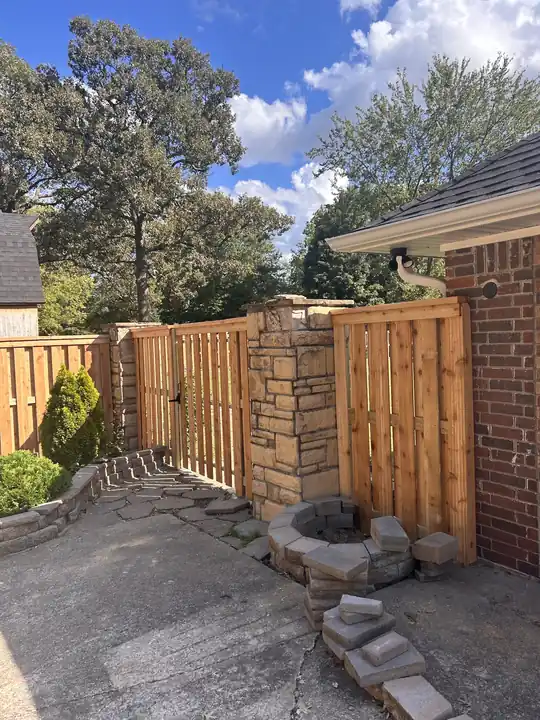
When you start pricing a wood privacy fence, you'll hear three style names over and over: dog-ear, board-on-board and shadowbox. They sound like catalog categories, but they describe very real differences in what the fence looks like, how much it blocks and how it handles wind. Here's what each one is, and what you'll see standing on either side of it.
Dog-ear: the straightforward privacy fence
A dog-ear fence is a single layer of upright boards, called pickets, with the top corners clipped off at an angle. The pickets are nailed or screwed to horizontal rails that run between the posts. It's the most common privacy fence in the country for a reason: it's simple, it goes up quickly and it looks tidy.
The catch is the rails. All the pickets get fastened to one face of the rails, so one side of the fence is flat and finished, and the other side shows the rails and posts. Neither side is wrong, but one of them is the pretty side. Most installers put the flat face outward, toward the street or the neighbor, which is why some people call this arrangement the good neighbor side. Decide up front which side you want facing out, because it's no fun to find out after the install.
Because every picket sits edge to edge, a dog-ear fence blocks the view well when it's new. As boards dry out and shrink, thin gaps can open between them, and that's normal for any single-layer wood fence.
Board-on-board: privacy that stays private
Board-on-board uses two layers of pickets. The first layer is spaced with small gaps, and the second layer goes over those gaps from the other side of the rails, overlapping the edges. When the wood shrinks, there's still a board covering every gap, so you don't get see-through slits over time.
Board-on-board also looks good from both sides. Since there are boards on each face of the rails, the fence shows a fuller, more finished pattern to you and to the neighbor alike. Add a cap board along the top and some trim, and it reads like a built feature of the property instead of just a barrier. The tradeoff is that it uses more lumber and more labor, and it's a heavier fence, so it asks more of the posts and the gates.
Shadowbox: looks the same on both sides
A shadowbox fence alternates the pickets from one side of the rails to the other, with small spaces between them. Look straight at it and you see a nearly solid wall. Look at an angle and you can see through the gaps. That alternating pattern creates a rhythm of light and shadow, which is where the name comes from.
The big advantage is that both sides look identical, so there's no bad side to argue about with the neighbor. Shadowbox also lets some air through. On open lots where the wind comes across a field, that can put less strain on the posts than a fence that acts like a solid sail. The tradeoff is that it isn't the most private option. If you want zero visibility from any angle, board-on-board is the better pick.
Gates deserve a thought in any of the three styles. A gate takes more abuse than the fence around it, and the style you choose should carry through to the gate so it doesn't look like an afterthought. On a shadowbox fence, for example, the gate can use the same alternating pickets, so it blends in instead of standing out as a flat panel in a patterned wall.
How to choose between them
- Maximum privacy, even as the wood ages: board-on-board.
- Simple and efficient, with a flat side and a rail side: dog-ear.
- Same look from both sides, with a little airflow: shadowbox.
- A fence that sits next to a patio, pool deck or front walk where people will study it up close: board-on-board with a cap and trim, or shadowbox.
Before you decide
Many cities and neighborhood associations have their own say about fence style, height and which side faces out. We aren't going to guess at those rules, so check with your city and your HOA before you settle on a design, and find out where your property line actually sits. A survey or a conversation with the neighbor now beats a conversation about a fence on the wrong side of the line later.
Fence Pros NWA builds privacy and shadowbox fences in cedar and in pressure-treated pine. If you're torn, call or text Sean at (479) 871-3942 for a free estimate and ask him to walk through the styles against your own yard. Standing in the spot where the fence will go makes the choice much more obvious.
Fence Pros NWA, (479) 871-3942
Call (479) 871-3942More articles
Why Fence Gates Sag, and What a Steel Frame Does About It
A gate is the one moving part on your fence, so it's the first place a cheap build shows.
Cedar or Pine for a Privacy Fence in Northwest Arkansas
Both woods work here, but they age differently, and knowing how helps you pick the one you'll be happy with.