Repair or Replace? How to Tell When an Old Fence Is Done
Some fences need three new boards. Others need to come out. The posts usually tell you which.
October 1, 2026 · 3 min read
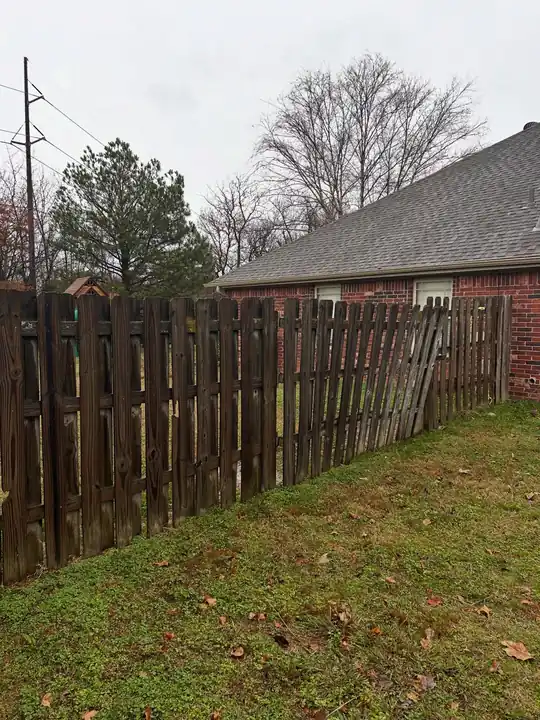
Nobody wants to replace a fence that only needs a repair, and nobody wants to keep patching one that's already finished. The trick is knowing which side of that line your fence is on. After a few seasons, wood fences all start to show wear, so the real question is where the wear is happening and how far it's spread.
Start at the posts
The boards are the part you see, but the posts are what hold everything up. Posts rot and fail at ground level, where they sit in wet clay. Walk the fence and push on each post. Then take a screwdriver and press the tip into the wood right at the soil line. If it sinks in easily or the wood crumbles, that post is rotting.
One or two soft posts is a repair. A line of them is a replacement, because the posts that haven't failed yet are living on borrowed time. The same goes for a fence that leans in long stretches instead of at one spot. A long, steady lean usually means the posts are giving way, and straightening the boards doesn't fix that.
Check the rails too. They're the horizontal pieces that tie the posts together, and the fasteners holding the pickets to them are where a fence quietly gives up. Look for nail heads that have backed out, rails that have split along the grain, and pickets that rattle when you shake them. Those problems are cheap to fix on their own, but if they show up everywhere along the run, the whole fence is telling you its age.
Signs a repair makes sense
- A handful of loose, cracked or missing pickets, with posts that are solid when you push on them.
- One section knocked down by a storm or a fallen limb, while the rest of the run stands straight.
- A single gate that drags or won't latch, on a fence that's otherwise sound.
- Rails that have pulled away in one spot, where a fresh rail and new fasteners will bring it back.
Signs it's time to replace
- Rot at the base of several posts, or posts that move when you lean on them.
- A fence that leans across a whole run instead of in one place.
- Boards that are splitting, cupping or soft across much of the fence, not just at a few spots.
- Repairs you've already made last year and the year before, and new problems showing up next to them.
There's a rough rule of thumb that works well. If you can fix the problem and what's left will stand for years, repair it. If you'd be fixing one section only to watch the next section go, you're paying twice, and that money is usually better spent on a new run.
The gate tells a story too
A gate that has sagged and been shimmed, braced and re-hung more than once is a sign the post or the frame is giving up. Replacing a worn-out gate with one built on a rigid metal frame often fixes the annoyance for good, even if the rest of the fence is staying. If the fence is older than the gate, though, make sure the gate post is solid first, or you'll be hanging a good gate on a bad post.
A middle path: replace the worst runs
You don't have to treat it as all or nothing. Many fences wear unevenly. The side that gets afternoon sun and weather ages faster, and a run near a downspout or a low spot rots sooner. Replacing the worst sections and repairing the rest can stretch a budget without leaving you with a fence that looks patched together. Fence Pros NWA does both new installation and repair on wood, metal, chain link, vinyl and farm fences, so the estimate can cover whichever mix actually makes sense.
Before anyone digs or tears out
If you're replacing posts, call 811 first so buried utilities get marked. Also find out whose fence it is. If it sits on a shared line with a neighbor, talk with them before work starts, and check with your city and HOA about anything that's changing, such as height or style, before you commit.
If you're not sure how far gone your fence is, call or text Sean at (479) 871-3942, Monday through Saturday, 7:30 AM to 7:30 PM, for a free estimate. He'll check the posts first and tell you straight if it's a repair or a rebuild.
Fence Pros NWA, (479) 871-3942
Call (479) 871-3942More articles
Why Fence Gates Sag, and What a Steel Frame Does About It
A gate is the one moving part on your fence, so it's the first place a cheap build shows.
Cedar or Pine for a Privacy Fence in Northwest Arkansas
Both woods work here, but they age differently, and knowing how helps you pick the one you'll be happy with.